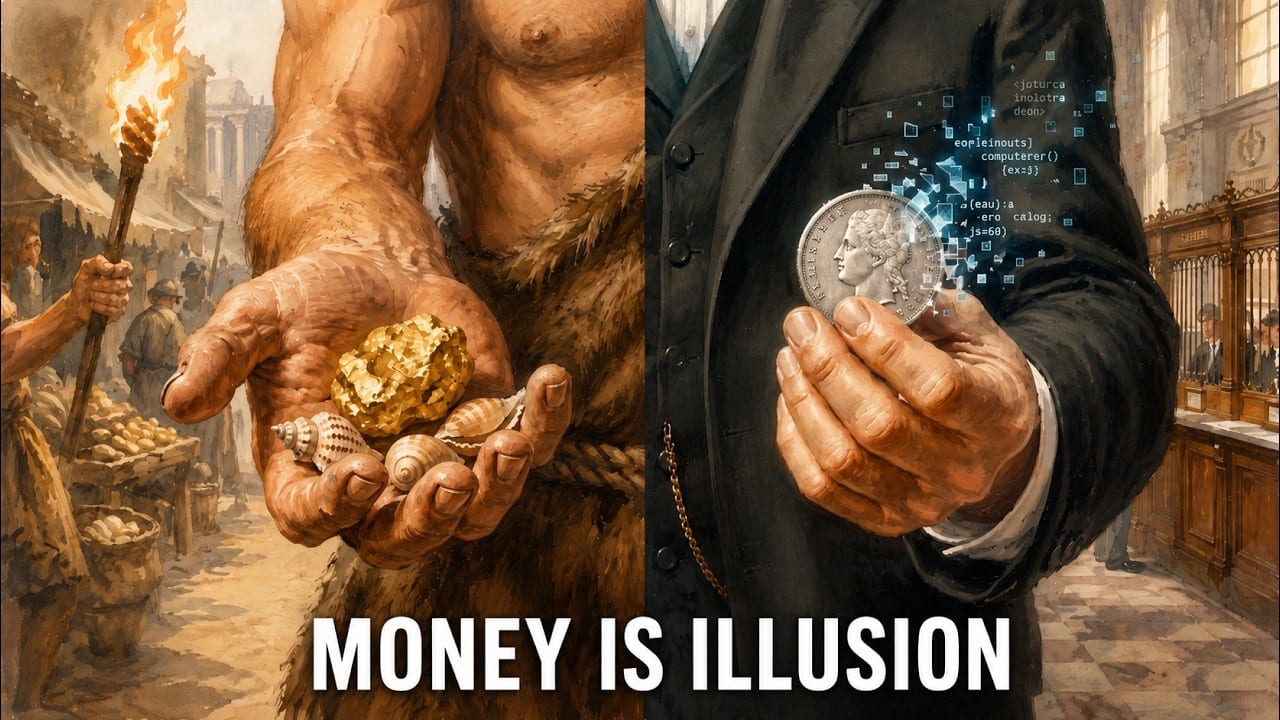
What is money, really? A hundred-dollar bill is just cotton and linen with ink on it, and yet people trade hours of their lives for it. This documentary explains where that value actually comes from.
It starts on the island of Yap, where four-ton limestone discs served as currency and one of the most valuable stones sits at the bottom of the ocean, still counted as valid money. From there it traces the whole arc: barley in ancient Sumer, the Mesopotamian shekel, the first Lydian coins, Chinese promissory notes and the world's first fiat currency, Isaac Newton's accidental gold standard, Bretton Woods, and the day Nixon closed the gold window. It ends on the shift happening right now, as one hundred and thirty-seven countries explore central bank digital currencies. The throughline is a single idea: money is a shared illusion built entirely on trust, and every form it has ever taken works only because enough people agree that it does.
What this video covers
- The Rai Stones of Yap, the oral ledger, and the stone at the bottom of the Pacific
- Why Milton Friedman compared Yap to the gold vault under the Federal Reserve Bank of New York
- The four functions economists use to define money
- Barley as the earliest known money in ancient Sumer, around three thousand BCE
- The Mesopotamian shekel and its origin as a unit of weight
- The Lydians and the first government-issued coins in the seventh century BCE
- Chinese promissory notes and the first paper fiat currency by eleven twenty
- How Isaac Newton accidentally put Britain on the gold standard in seventeen seventeen
- Bretton Woods, thirty-five dollars per ounce, and the dollar as reserve currency
- The Nixon shock of August fifteen, nineteen seventy-one, and the end of the gold standard
- Yuval Noah Harari on money as the most successful story ever told
- George Washington's warning about paper money, and the hyperinflations that proved it
- Why more than ninety percent of all money exists only as data on servers
- Central bank digital currencies, the digital rupee and digital yuan, and the surveillance objection
The full narration 6 min read
Money. Look at a hundred-dollar bill. It’s just cotton and linen with some ink on it. So why would someone trade hours of their life, or actual goods, just to get it? The answer lies in a shared global hallucination. Today, we’re breaking down exactly what money is, how it gets its value, and why our entire modern world depends on this invisible trust.
Let’s start with something that might sound ridiculous. On a tiny island called Yap, in the western Pacific Ocean, people used giant limestone discs as money. These are called Rai Stones. Some stood thirteen feet tall and weighed four tons. You couldn’t exactly carry one to the market. So instead of moving them, the islanders kept an oral ledger. Everyone in the community simply agreed on who owned which stone. The stone didn’t move. Ownership did.
Here’s where it gets truly fascinating. One of the most valuable Rai Stones on the island sits at the bottom of the ocean. It sank during transport generations ago. But the people of Yap still counted it as valid currency. Everyone agreed it existed. Everyone agreed who owned it. That agreement was all that mattered.
Before you laugh at the idea of underwater money, consider this. Economist Milton Friedman pointed out that this system wasn’t so different from how the Federal Reserve Bank of New York operates. Gold bars sit in a vault. When one government pays another, the gold doesn’t leave the building. Workers simply move bars from one shelf to another. The gold doesn’t go anywhere. Ownership does. Sound familiar?
This brings us to the fundamental question. What is money, really?
Economists define money by four primary functions. It’s a medium of exchange, meaning you can trade it for goods and services. It’s a unit of account, giving us a way to measure and compare value. It’s a store of value, holding its worth over time. And it sometimes serves as a standard of deferred payment, letting people settle debts in the future. Any item that reliably performs these functions can become money. Throughout history, humans have gotten incredibly creative about what that item is.
The earliest known money appeared around three thousand BCE in ancient Sumer. It was barley. Literal grain. Fixed amounts of barley were used as a universal measure to evaluate and exchange all other goods. This was money with genuine intrinsic value. You could eat it. You could plant it. It had worth independent of any agreement or government decree. Around the same time, the Mesopotamian shekel emerged as a unit of weight based on roughly one hundred sixty grains of barley.
From barley, humanity graduated to metals. Then to coins minted by kings. The Lydians struck the first government-issued coins in the seventh century BCE. Metals like gold and silver became dominant because they were durable, divisible, portable, and scarce. They held intrinsic value because people genuinely wanted them, not just as currency, but as material.
But precious metals had limits. They’re heavy. They’re finite. And economies kept expanding.
So in the seventh century CE, Chinese merchants started writing promissory notes. Instead of hauling coins around, they exchanged pieces of paper that represented deposits held elsewhere. By eleven twenty, the Chinese government was printing the world’s first fiat currency. Paper money is backed not by weight or metal, but by decree.
This idea spread slowly westward. Britain accidentally slipped into a gold standard in seventeen seventeen when Isaac Newton, serving as master of the Royal Mint, set the exchange rate of silver to gold too low. By the 1870s, the gold standard anchored the entire international monetary system. Paper money existed, but it was a promise. A claim on something real sitting in a vault.
Then came the twentieth century, and everything changed.
In nineteen forty-four, delegates from forty-four countries gathered in Bretton Woods, New Hampshire, and agreed to peg their currencies to the U.S. dollar, which itself was convertible to gold at thirty-five dollars per ounce. The dollar became the world’s reserve currency. But as the global economy expanded, the math stopped working. There wasn’t enough gold to back all the dollars in circulation.
On August fifteen, nineteen seventy-one, President Richard Nixon suspended the dollar’s convertibility to gold. By nineteen seventy-three, the gold standard was dead. And in October nineteen seventy-six, the U.S. government officially removed all references to gold from the legal definition of the dollar.
Just like that, the most powerful currency on Earth became pure fiat. Its value rested entirely on trust.
That trust, it turns out, is remarkably powerful. As Yuval Noah Harari put it, money is probably the most successful story ever told. It has no objective value. But the storytellers, the bankers, the finance ministers, they tell a very convincing story. Harari called money the most universal and most efficient system of mutual trust ever devised. It bridges cultures. It doesn’t discriminate by religion, gender, or race. It is, in his words, the apogee of human tolerance.
But here’s the thing about stories. They can unravel.
George Washington warned about it in seventeen eighty-seven, writing that paper money would ruin commerce and open a door to every species of fraud and injustice. History proved him partially right. Hyperinflation destroyed the currencies of Weimar Germany, Zimbabwe, and Venezuela. When governments print too much money, the shared illusion breaks down.
The fiat system persists anyway. Most economists agree it’s better suited for complex modern economies, as long as it’s well managed. The alternative, tying currency to a physical commodity, creates its own problems. Rigid money supplies can’t respond to crises. Economies can be strangled by the very anchor meant to stabilize them.
Today, the scale of this trust-based system is staggering. Global M2 broad money supply reached approximately one hundred and forty-two trillion dollars in twenty twenty-five. But physical cash, actual coins and banknotes, accounts for less than six trillion of that. More than ninety percent of all money exists only as electronic data on computer servers through fractional reserve banking systems, where banks create money by lending out deposits they don’t physically hold. When your employer pays you, no one moves a stack of bills. Numbers shift from one database to another. That’s it.
If you divided all the world’s liquid money equally among every human being, each person would receive about fifteen thousand dollars. But of course, it’s not divided equally. The top one percent of adults control nearly half of global financial wealth. Total personal wealth across fifty-six markets hit four hundred and seventy-one trillion dollars in twenty twenty-four.
The transformation isn’t slowing down. Right now, one hundred and thirty-seven countries representing ninety-eight percent of global GDP are exploring central bank digital currencies. India’s digital rupee pilot grew three hundred and thirty-four percent in a single year. China is pushing the digital yuan. The European Central Bank is piloting a digital euro. These CBDCs represent a fundamental shift from traditional cryptocurrency models like Bitcoin, which operate without central bank control. Meanwhile, the United States has moved in the opposite direction. In January twenty twenty-five, President Trump signed an executive order halting all federal work on a retail CBDC, making the U.S. the only country to actively block its development.
The concerns aren’t trivial. Critics warn that digital currency could become an extension of the surveillance state, with governments able to monitor every transaction, freeze wallets, or fine citizens instantly for behaviors deemed undesirable. The shared illusion of money works partly because cash is anonymous. Take that away, and the social contract changes.
So where does this leave us? Standing at the edge of yet another transformation. Money started as barley you could eat. It became metal you could hold. Then paper you could fold. Then numbers on a screen. And soon, digital code controlled by algorithms.
But through every evolution, one thing has never changed. Money works because we believe it works. A hundred-dollar bill is worth a hundred dollars for the same reason a four-ton limestone disc at the bottom of the Pacific Ocean is worth a fortune. Because enough people agree that it is.
Whether it’s fiat currency or central bank digital currency, money is, and has always been, a shared illusion. The most powerful one our species has ever created.