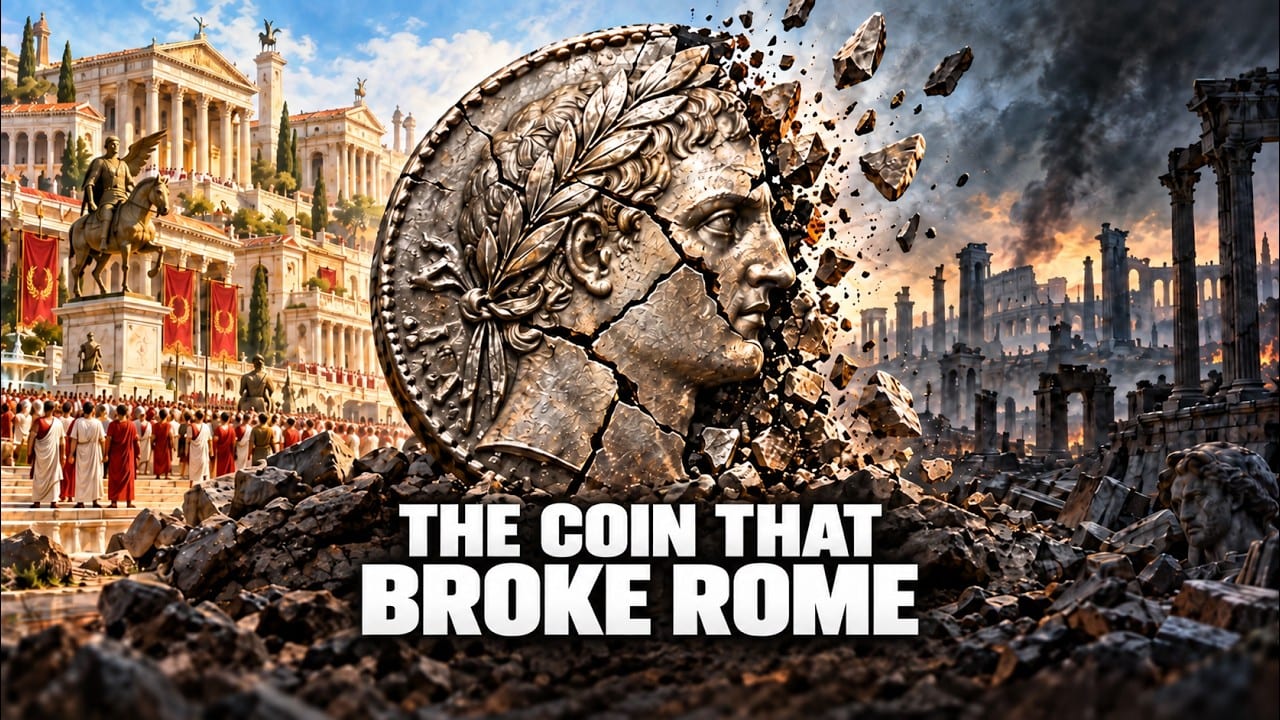
The Spanish piece of eight never lost a grain of silver in three centuries. It was the most trusted coin on Earth, legal tender from Amsterdam to Manila to the United States. And the empire that minted it, the empire pulling more silver out of the ground than the rest of the world combined, went bankrupt four times in forty years while that coin was in circulation.
This is the story of how Spanish silver ruined Spain.
We follow the silver from the moment Diego Hualpa finds it at Cerro Rico in 1545, through the forced labour of the mita and the mercury amalgamation introduced by viceroy Francisco de Toledo, into the treasure fleet convoys organised by Pedro Menéndez de Avilés and the ledgers of the Casa de Contratación in Seville. Then we watch what happens when it lands. Earl Hamilton's archival price series show Spanish prices rising four to seven times over a century and a half, the Price Revolution, at a moment when nobody alive had ever seen prices move at all.
Chapters 14 parts
The full narration 7 min read
The Spanish piece of eight is the most honest coin ever minted, and the story of how it helped destroy the empire that made it.
For roughly three centuries, the Spanish piece of eight held the same weight and the same purity. Twenty-seven and a half grams of metal, a little over ninety-three percent of it pure silver. It never got lighter. It never got quietly cheaper. And the country that struck it, the country pulling more silver out of the ground than the rest of the world combined, went bankrupt four separate times in forty years while that coin was circulating.
If you’ve seen our video on the economics of the Roman Empire’s collapse, you already know the other version of this story. Rome shaved its silver coin down over two and a half centuries, from almost pure metal to a copper slug with a silver wash, and prices came apart. The lesson everybody takes from Rome is that the empire lied about its money, and the lie eventually caught up with it.
Spain is the reason that lesson is wrong.
Spain didn’t lie. The coin was exactly what it claimed to be, and the same thing happened anyway.
The standard was set in fourteen ninety-seven, in a decree issued at Medina del Campo under Ferdinand and Isabella. Eight reales, struck to a fixed weight, at a fineness of one hundred and thirty-four parts in one hundred and forty-four. Twenty-five and a half grams of fine silver in every single coin. The real de a ocho. The piece of eight.
That coin became the first genuinely global currency in history. It circulated in Amsterdam and Antwerp, in the ports of West Africa, in Manila, and in Canton, where Chinese merchants weighed it and stamped it and passed it along. The route to Manila ran through the Pacific aboard the Manila Galleons, a regular trade system that carried American silver west to Asia and brought silk and porcelain east in return. It was still legal tender in the United States until eighteen fifty-seven, decades after the Spanish empire that minted it had stopped mattering to anyone. That’s what a trusted coin looks like. It’s also the thing the gold standard was later supposed to give us, because the history of gold as money is largely a history of people trying to rebuild exactly this, money that can’t be fiddled with.
Spain had it. Spain had the real thing.
Then Spain found the mountain.
In fifteen forty-five, in what’s now Bolivia, a man named Diego Huallpa found silver in a peak the Spanish would come to call Cerro Rico. The Rich Hill. It stands at nearly fifteen thousand feet, in air thin enough to make walking difficult, and it turned out to be the greatest concentration of silver ever discovered.
At its peak, around sixteen hundred, Potosí was producing something like nine million silver pesos a year. That was more than every other silver mine then operating on the planet, added together. Between fifteen forty-five and eighteen ten, that one mountain accounted for close to a fifth of all the silver human beings have ever mined.
Getting it out took forced labour. The Spanish took an Andean system of rotational service called the mita and turned it into a permanent draft, pulling men from communities across the highlands and sending them into the tunnels. In fifteen seventy-two, the viceroy Francisco de Toledo introduced mercury amalgamation, which let the Spanish process low-grade ore they’d previously thrown away. The mercury itself came largely from the Almadén mines in Spain, which were at that time leased to the Fugger banking family of Augsburg. It also meant workers handling liquid mercury with bare hands and breathing its vapour underground.
You’ll often hear that eight million people died at Potosí. That figure comes from a political book published in nineteen seventy-one, and historians who’ve worked through the actual records can’t support it. The documented reality is bad enough without it. Potosí consumed people at a rate that emptied whole districts of the Andes, and it did so for two hundred and fifty years.
Everything that mountain produced was supposed to pass through one building.
The Casa de Contratación, the House of Trade, sat in Seville, and every ounce of registered American silver was meant to be recorded there. From fifteen sixty-four, under a system organised by Pedro Menéndez de Avilés, that silver crossed the Atlantic in convoy. Two armed fleets a year, sailing on a schedule, because a lone galleon carrying a mountain’s worth of bullion was an invitation to every navy and privateer in the Atlantic.
The system worked. That’s the part people miss. The fleets mostly got through.
And that’s precisely what ruined Spain.
We can measure it, too. In nineteen thirty-four, an economist at Duke University named Earl Hamilton published a book called American Treasure and the Price Revolution in Spain. Hamilton and his wife Gladys had spent years inside Spanish archives copying out prices by hand, hundreds of thousands of individual observations, building price series for one hundred and fifty-eight different goods across Andalusia, Valencia, and both Castiles. Nobody had ever assembled anything like it.
What the numbers showed was that as the registered silver came in, prices went up. Hamilton counted around two hundred and ten million pesos of American treasure arriving in the sixteenth century alone, and roughly a hundred and sixty million of that landed in the second half.
Over a hundred and fifty years, Spanish prices rose somewhere between four and seven times over. Hamilton’s own figure was a factor of three point seven between fifteen fourteen and sixteen oh three. More recent work, using better data, puts it closer to seven.
Work that out annually and it comes to somewhere between one and one and a half percent a year. Today we’d call that a stable economy.
But nobody in fifteen hundred had ever seen prices move at all. For most of the medieval period, a loaf of bread cost roughly what it had cost in your grandfather’s time. Prices were treated as a fact about the world, like the weather. Slow, grinding, permanent inflation was a genuinely new phenomenon, and it arrived attached to what everyone had been told was the greatest windfall in the history of Christendom.
Someone did figure it out. In fifteen fifty-six, a Spanish priest and legal scholar named Martín de Azpilcueta, working at Salamanca, wrote the mechanism down. Money, he argued, is worth more where it’s scarce and less where it’s abundant, and the reason Spanish prices kept climbing was that Spain was drowning in silver. That’s the quantity theory of money, stated plainly, twelve years before Jean Bodin got the credit for it in France. Bodin published his own analysis in fifteen sixty-eight, drawing on the French experience of the same influx of American silver, and reached essentially the same conclusion by a different route. Two scholars, two countries, one answer.
A Spanish scholar diagnosed Spain’s disease while it was still happening. The Spanish crown did not act on it.
Instead, the crown borrowed against the fleets.
Silver on a ship is silver you haven’t got yet. So Philip the Second’s government took out short-term loans called asientos, and repaid them when the galleons docked. In the early decades, the Fugger family of Augsburg were among the most important of those creditors, financing Spanish military ambitions across Europe in exchange for access to crown revenues. Wars in Flanders and against the Ottomans cost more than the mountain produced, and the loans kept getting bigger.
In fifteen fifty-seven, within about a year of taking the throne, Philip suspended payments. The Fuggers absorbed catastrophic losses, and lending dominance gradually shifted toward Genoese banking networks. He did it again in fifteen sixty. When silver remittances came in badly three years running, he did it again in fifteen seventy-five, this time stopping payment on fourteen and a half million ducats. And in fifteen ninety-six, the Genoese finally refused to extend any more credit, and Spain defaulted for a fourth time.
Four sovereign defaults, while the richest silver mine in human history was running at full capacity.
The silver arrived in Seville and left again almost immediately. Out to Genoese and German creditors, out to Flanders to pay soldiers, out to Asia to buy silk and porcelain. Spain worked as a channel the metal passed through rather than a place it stayed.
Spain did eventually reach for the old trick. From fifteen ninety-nine onward the crown began debasing its copper coinage, the vellon, the small change ordinary Spaniards actually used from day to day, and that produced its own separate catastrophe in the sixteen hundreds. But that came afterwards. The price revolution was already most of the way through by then, and it had happened while the silver was still good.
So go back to the coin.
The piece of eight never lied. Nobody clipped it, nobody quietly cut its silver with copper, nobody swapped the metal out and hoped the public wouldn’t notice. By any measure you like, it was one of the most honest pieces of money ever produced, and it stayed honest long enough to outlive the empire that produced it.
Rome debased its coin and got inflation. Spain refused to debase its coin, and got inflation. The two most famous currency collapses in money history run in opposite directions and arrive at the same place, which tells you that the integrity of the coin was never the thing doing the work.
What matters is how much of it there is. That’s it. A perfect coin, minted in unlimited quantity, behaves exactly like a fraudulent one. Azpilcueta wrote that down in fifteen fifty-six, and we’ve been relearning it ever since, every time a government decides that the way out of a problem is more money.
Spain didn’t debase its silver. Spain just found too much of it.
Sources 9
- Earl J. Hamilton, American Treasure and the Price Revolution in Spain, 1501–1650 (Harvard UP, 1934) — archive.org
- John Munro, The 16th-Century Price Revolution: Causes and Consequences — University of Toronto
- Spanish dollar (real de a ocho) — standard, weight and fineness
- Price revolution
- Martín de Azpilcueta — first explicit statement of the quantity theory of money, 1556
- Spanish treasure fleet — convoy system from 1564
- Kris Lane, Potosí (New World Objects of Knowledge, University of London Press)
- Debt and Default in the Age of Philip II, 1556–1598 — Banco de España working paper
- The Silver of the Conquistadors — World History Encyclopedia