Out of one hundred and eighteen elements on the periodic table, humanity ended up using one as money. That wasn't an aesthetic choice or an accident of culture. It was an elimination test, and almost every element failed it.
In two thousand eleven, Planet Money handed the periodic table to Columbia chemical engineer Sanat Kumar and asked which element you could build a currency from. He didn't pick one. He crossed things out. Gases blow away. Lithium and cesium catch fire. Einsteinium kills whoever carries it. Iron rusts, copper turns green, osmium is too rare to ever gather, and platinum melts at temperatures no ancient furnace could reach. Silver survives almost to the end, then tarnishes.
This video runs that test from start to finish, then puts it to the ultimate proof: aluminum. The most abundant metal in Earth's crust, it was worth as much as silver in eighteen eighty-four and capped the Washington Monument. Two years later a chemist made it cheap, and it stopped being money forever.
The full narration 7 min read
This is the story of how gold beat out one hundred and seventeen rivals to become money. Not because anybody chose it, but because almost everything else on the periodic table was disqualified.
In two thousand eleven, the radio program Planet Money put that idea to Sanat Kumar, a chemical engineer at Columbia University. They handed him the periodic table and asked which element he’d build a currency out of. Kumar didn’t start by picking one. He started by crossing things out.
That’s the real history of gold as money. Not a decision. An elimination test.
So let’s run it.
Start on the far right of the table, with the noble gases. Helium. Neon. Argon. Krypton. Xenon. Chemically, these are close to perfect, because they refuse to react with anything, which is exactly what you want in something that has to survive being handed around for centuries. But they’re gases. Add hydrogen, nitrogen, oxygen, fluorine and chlorine, and eleven elements are gone before you’ve properly started. You can’t carry a gas in your pocket. Open the jar, and your life savings are in the room. A moment later, they’re in the sky.
Now go to the far left of the table, and the problem inverts.
Lithium. Sodium. Potassium. Cesium. These metals are so desperate to react that they’re dangerous to simply own. Expose lithium to air and it can start a fire hot enough to burn through a concrete wall. Drop cesium into water and it explodes. Kumar crossed off thirty-eight elements on reactivity alone, which meant a tenth of the table was gone in a single stroke. A currency that catches fire in the rain isn’t a currency.
Then comes the category that eliminates itself. Einsteinium. Plutonium. Radium. The radioactive elements. Put einsteinium in your pocket, and a year later you’re dead. Money isn’t supposed to kill the person holding it.
Keep cutting.
Iron is one of the most common elements on Earth, and it rusts. Copper turns green. Lead is soft enough to mark with a fingernail and poisonous enough to be a public health emergency. Anything too abundant fails for a completely different reason, because if you can pick it up off the ground, it can’t store value. Everybody can just make more of it whenever they feel like it.
But go too far the other way, and you fail again. Osmium is a dense, stable, perfectly good metal. It’s also so vanishingly rare that no society could ever gather enough of it to pay for anything, and a currency nobody can accumulate isn’t a currency either.
And then there’s heat.
Money has to be divisible. You have to be able to melt it, weigh it, and strike it into identical pieces, because otherwise you can’t make change and you can’t make a coin. That single requirement wipes out an entire class of metals, since an ancient furnace has a ceiling. Titanium doesn’t turn liquid until roughly three thousand degrees Fahrenheit. For most of human history, that may as well have been the surface of the sun.
Run every one of those filters, and one hundred and eighteen elements collapse down to five.
Platinum. Palladium. Rhodium. Silver. Gold.
Three of them fall away almost immediately.
Palladium and rhodium weren’t even known to exist until the early eighteen hundreds, when the English chemist William Hyde Wollaston pulled them out of crude platinum ore. You can’t build five thousand years of money history on a metal nobody had discovered yet.
Platinum failed for the same reason titanium did. It melts at over three thousand two hundred degrees Fahrenheit, which is hotter than iron. Spanish miners in South America kept finding it tangled into their gold deposits and treated it as a nuisance. They called it platina. Little silver. And they threw it back, because there wasn’t a furnace anywhere in the world that could do anything useful with it.
Which leaves two, and this is where it gets genuinely interesting, because silver and gold are very nearly the same answer.
Silver is beautiful, workable, and melts at a temperature any competent ancient smith could reach. For long stretches of history it was the more practical of the two, the everyday coin, the wage, the price of bread. The Lydians understood this better than anyone. Around six hundred BCE, in what is now western Turkey, they struck the first true coins from electrum, a naturally occurring alloy of gold and silver pulled straight from local rivers. Within a generation they had separated the two metals and were minting pure gold coins — the earliest standardized gold currency the world had seen. But silver has one flaw, and the flaw is chemical. Silver reacts with sulfur in the air. It tarnishes. It goes black.
Gold does not.
Gold doesn’t rust. It doesn’t tarnish, it doesn’t corrode, and it won’t dissolve in any single common acid. It takes aqua regia, nitric and hydrochloric acid mixed together, to attack it at all. Pull a gold coin off a shipwreck after four hundred years on the seabed, and it comes up looking like it was struck last week. Pull up a silver one, and it comes up black.
That inertness isn’t a cosmetic detail. It’s the whole reason gold behaves like money across centuries instead of decades, and you can watch it operate in the economics of the Roman Empire’s collapse. Rome’s silver coinage could be quietly cut with cheaper metal, and emperor after emperor did exactly that. Rome’s gold was far harder to falsify, because gold’s density and its refusal to react give a fake away. A metal that will not change is a very difficult thing to lie about. It’s a principle that would echo forward two thousand years to Bretton Woods in nineteen forty-four, when forty-four nations gathered in New Hampshire and anchored the entire global monetary system to gold at thirty-five dollars a troy ounce — because no other substance had ever managed to hold its value reliably enough across enough centuries to earn that kind of trust.
But here’s the thing that proves the whole rule.
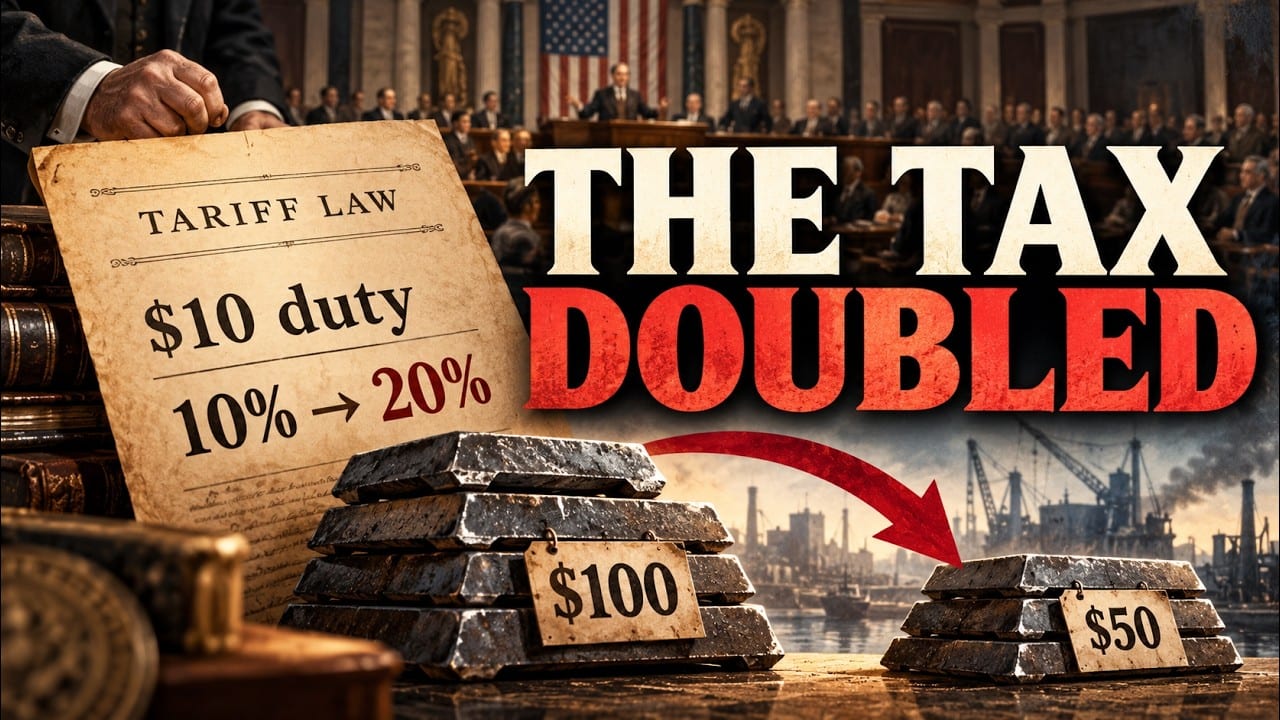
The most abundant metal in the Earth’s crust is aluminum. And in eighteen eighty-four, aluminum was one of the most expensive substances on the planet.
When the Washington Monument was completed that year, the builders capped it with a pyramid of solid aluminum, just under nine inches tall and weighing one hundred ounces, the largest piece of pure aluminum that had ever been cast. It cost about a dollar ten an ounce. That made it roughly as valuable as silver, and it meant a single ounce of the stuff was worth about what a laborer on that monument earned for a ten-hour day.
Less than two years later, a young American chemist named Charles Martin Hall worked out how to separate aluminum from its ore using electricity. Paul Héroult arrived at the same process in France at almost the same moment, and that’s when the price collapsed. Within a generation, the metal that crowned America’s tallest monument was being thrown away in the form of drink cans.
Aluminum never changed. What changed was how hard it was to get.
And that’s the final filter, the one that catches everything the others miss. The scarcity has to be permanent. It has to come from physics rather than from the limits of your technology, because technology improves, and the moment it does, your money evaporates. Gold has never had that problem. We’ve been hunting it for more than five thousand years, with slaves and with steam, with dynamite, with cyanide, with satellites, and it has stayed rare through every one of them.
You can see exactly how rare.
The World Gold Council’s twenty twenty-four report puts the total at roughly two hundred and sixteen thousand tons of gold ever mined in human history. Melt every gram of it, every wedding ring, every bar in every vault — including the hundred and forty-seven million troy ounces sitting in Fort Knox — every gold tooth, every mask lifted out of every tomb, and it forms a single cube about twenty-two meters on a side, a little over seventy feet. It would sit comfortably on a tennis court and stand about as tall as a seven-story building. That’s the entire supply, for the whole species, for all of recorded time.
And because gold doesn’t corrode, almost every gram of it is still here. The gold in a ring on somebody’s hand this morning may have spent a few centuries as a Roman coin, and a few thousand years before that as an Egyptian pendant.
So nobody chose gold.
One hundred and eighteen elements went into the test. The gases blew away. The reactive metals caught fire. The radioactive ones killed whoever carried them. The common metals rusted, and the rare ones could never be gathered. The stubborn ones couldn’t be melted. Silver went black. And aluminum was disqualified the day somebody made it easy.
Gold was simply what was left standing.
Dozens of civilizations that never met, never traded, and never shared a language ran this same experiment on their own, across thousands of years, and kept arriving at the same soft yellow metal. Not because they shared a culture.
Because they shared a periodic table.
Sources 5
- Royal Society of Chemistry — Chemistry in its element: platinumperiodic-table.rsc.org