The Smoot-Hawley Tariff became more burdensome as prices collapsed during the Great Depression. But Congress never voted on that extra increase.
In June 1930, Congress passed the Tariff Act of 1930 and Herbert Hoover signed it. That vote happened in the open, 44 to 42 in the Senate. This documentary is about what came afterwards: how deflation took a law that was already on the books and made it heavier, year after year, without anyone changing a word of it.
Chapters 16 parts
The full narration 7 min read
This is the story of a tax that nobody in America ever voted for — and of the money system that passed it in secret.
In the summer of nineteen thirty, Congress set the import duty on pig iron at one dollar and twelve and a half cents per ton. Not a percentage of the price. A fixed number of cents, written into the law and left there. That single drafting choice, repeated across thousands of lines of legislation, turned an ordinary act of Congress into something that kept growing long after everyone stopped voting on it.
A duty written in dollars only means what the dollar means. And in the years right after nineteen thirty, the dollar changed.
The law was the Smoot-Hawley Tariff — formally the Tariff Act of nineteen thirty — named for Reed Smoot, the senator from Utah who chaired the Finance Committee, and Willis Hawley, the congressman from Oregon who ran Ways and Means. It began as a narrow promise to help American farmers, who had been struggling for most of the decade. It did not stay narrow. Once a tariff bill is open, every industry in the country arrives with a list, and every vote has a price. By the time it reached the President’s desk, the bill raised duties on more than twenty thousand separate items.
Here’s the part that almost every version of this story leaves out.
Most of those duties were what economists call specific duties. A specific duty is a flat charge on a physical quantity. So many cents per pound of sugar. So many dollars per ton of iron. It doesn’t move with the price of the thing, because it isn’t attached to the price of the thing. It’s attached to the weight, or the count, or the volume. Roughly two-thirds of everything the United States taxed at the border was taxed that way.
When prices hold steady, that distinction is a technicality. When prices collapse, it becomes the whole story. If a ton of iron costs a hundred dollars and the duty is ten dollars, that’s a ten percent tax. Let the price of that same ton fall to fifty dollars, and the duty doesn’t fall with it. The tax is still ten dollars, and now it’s twenty percent. The law hasn’t changed. Not one word of it, not one number in it. But the burden has doubled, and no one had to vote for it.
Congress passed one tariff in nineteen thirty. The money supply passed a second one, quietly, over the three years that followed.
Before any of that happened, the economists tried to stop it.
In March of nineteen thirty, at Swarthmore College, a professor named Clair Wilcox suggested that the profession ought to say something. Paul Douglas of the University of Chicago, who was teaching at Swarthmore that term, wrote the statement. They sent it to colleagues at the major universities: Frank Graham at Princeton, Henry Seager at Columbia, Ernest Patterson at Pennsylvania, Frank Taussig at Harvard, and Irving Fisher at Yale, the most famous economist in America.
Fisher suggested mailing it to every single member of the American Economic Association. More than two thousand five hundred letters went out, stuffed by Swarthmore students. The entire campaign cost less than one hundred and forty dollars, and Irving Fisher paid one hundred and five of it out of his own pocket.
Within ten days, nearly a thousand economists had signed.
Wilcox hand-delivered the statement to President Hoover, to Senator Smoot, and to Congressman Hawley, then released it to the press on Monday, May third, nineteen thirty. Two days later, Senator Pat Harrison read the whole thing into the Congressional Record over the names of one thousand and twenty-eight economists. Before the signatures stopped arriving, the count passed twelve hundred and fifty. It remains the largest unified public warning American economists have ever issued about anything.
And read now, it is uncomfortably specific.
Higher duties, they wrote, would raise the cost of living and injure the great majority of our citizens. The vast majority of farmers would lose, because cotton and corn and wheat are sold into a world market and have no serious competition at home. Other countries would pay us back in kind by levying retaliatory duties against our goods. They even quoted Hoover’s own words back at him, from a message he had sent to Congress the previous April. It is obviously unwise protection, he had written, which sacrifices a greater amount of employment in exports to gain a less amount of employment from imports.
Their last line was the one that aged the worst. A tariff war, they wrote, does not furnish good soil for the growth of world peace.
The Senate passed the bill on June thirteenth by forty-four votes to forty-two. The House passed it the next day. Thomas Lamont, a senior partner at J.P. Morgan and one of the most powerful bankers alive, later said he almost went down on his knees to beg Herbert Hoover to veto the asinine Hawley-Smoot tariff.
Hoover signed it on June seventeenth, nineteen thirty. Paul Douglas, writing his memoirs decades later, was oddly generous about it. He thought Hoover had wanted to take their advice, and simply couldn’t. The President’s party was committed to protection, and the President was not stronger than his party.
Retaliation did not take years. It had already started.
Canada moved first, in May, before the bill was even law, with countervailing duties on sixteen American products that made up around thirty percent of everything the United States sold to Canada. That July, Canadians elected Richard Bedford Bennett as Prime Minister, a Conservative who had campaigned on hitting back harder, and he raised the duties again. Spain’s Wais tariff, also that July, put charges of one hundred to one hundred and fifty percent on American automobiles. Italy had already roughly doubled its duty on popular American cars in June. Switzerland skipped tariffs altogether and organized consumer boycotts, with Swiss banks and government offices refusing to buy American equipment.
Within two years, some two dozen countries had raised their own walls. The League of Nations later calculated that the volume of world trade fell by more than sixty-five percent between nineteen twenty-nine and nineteen thirty-three.
And underneath all of it, the quieter thing was happening.
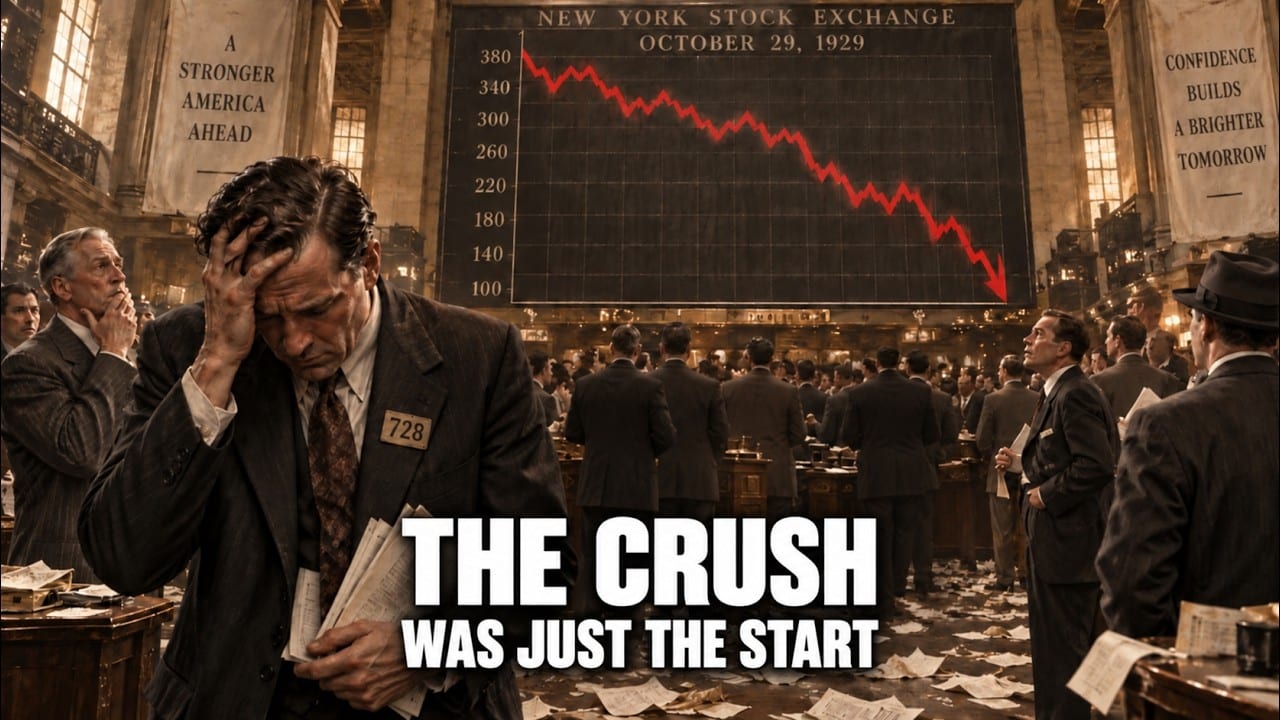
Prices in the early nineteen thirties did not drift downward. They fell off a cliff. The United States was on the gold standard, which meant the money supply was tied to gold reserves — and as banks failed and the Federal Reserve tightened its grip rather than expanding credit, the supply of money contracted sharply. Prices had no choice but to follow. Every one of those specific duties, the cents per pound and the dollars per ton, held its ground while the value of what it was charged against dropped away beneath it.
The numbers are stark. The Dartmouth economist Douglas Irwin has spent much of his career reconstructing what this law actually did. He found that the average duty collected on taxable imports stood at about forty percent in nineteen twenty-nine. By nineteen thirty-two it was about fifty-nine percent. Nineteen points. But Smoot-Hawley itself, the bill that took a year of hearings and horse-trading and cost two politicians their careers, accounts for only a small share of that jump. Estimates of the Act’s own contribution vary, but they cluster in the low single digits, somewhere between two and six percentage points.
Deflation did the rest.
That is the strange arithmetic at the center of this story. The most notorious protectionist law in American history was mostly not passed by Congress. It was passed by falling prices, acting on words that were already sitting in the statute book.
Set that beside the rest of the money history record, and it runs backwards. Currencies usually die from too much. In Portugal, five years before Smoot-Hawley, one man’s forgery crashed an entire country’s economy, and the strangest part is that the forged document was a contract. The banknotes it produced were completely real, printed by the official printer from the official plates. Rome debased. Revolutionary France printed. The American case in the early nineteen thirties was the opposite failure: not too much money, but too little, and a legal code that quietly rewrote itself as the money got scarcer.
Both Smoot and Hawley lost their seats in nineteen thirty-two. Two years later, Congress did something it had never done before. Under Franklin Roosevelt’s Secretary of State, Cordell Hull, it passed the Reciprocal Trade Agreements Act. That law handed the power to set tariffs over to the President, on the theory that Congress could no longer be trusted with it. That transfer of power became the model for the General Agreement on Tariffs and Trade in nineteen forty-eight, which became the World Trade Organization. The entire architecture of modern global trade is, in a real sense, an apology for nineteen thirty.
The honest verdict on Smoot-Hawley is that it did not cause the Great Depression. Trade was too small a share of the American economy for that, and the historians who have measured it carefully say so. What it did was turn a national collapse into a global one, and poison the international system for a generation.
But go back to that one line in the statute. One dollar and twelve and a half cents per ton.
Congress debated that number for months. Lobbyists fought over it. Newspapers printed it. One thousand and twenty-eight economists signed their names to a letter begging the President to stop it.
And then the dollar quietly appreciated, the gold standard held the money supply in a vice, the Federal Reserve looked the other way, and the real tax doubled — and there was no debate, no vote, no letter, and no signature. Every price ever written down is a bet on what the money will be worth later. In nineteen thirty, the United States wrote twenty thousand of those bets into law, and then lost almost every one of them.
Sources 8
- Congressional Record–Senate, May 5, 1930, pp. 8327–8330 (petition text + 1,028 signatories) — via the above
- Britannica, "Smoot-Hawley Tariff Act"britannica.com
- Britannica, "Reciprocal Trade Agreements Act"britannica.com