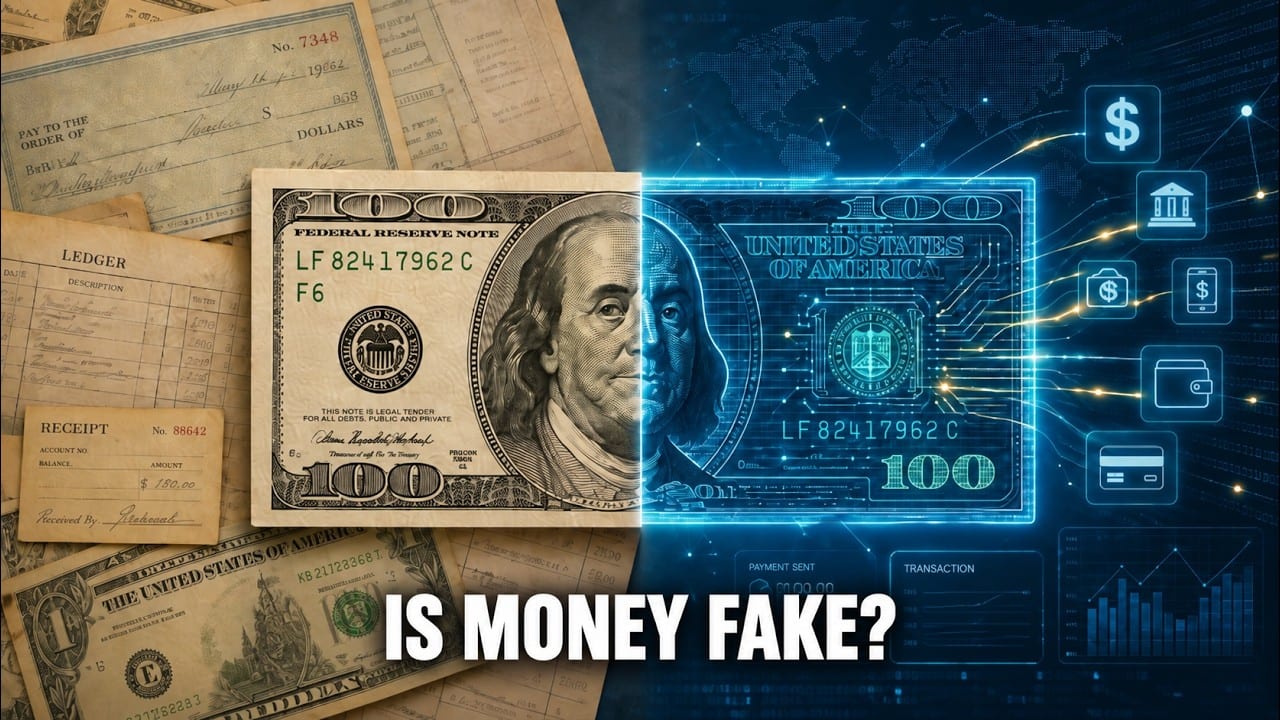
Money did not start with coins or paper bills. It started with a problem: barter's double coincidence of wants.
This documentary follows six thousand years of money in ten minutes, from Mesopotamian barter, cowrie shells and salt wages to the first electrum coins of Lydia, Chinese paper money, the gold standard, Bretton Woods, Nixon's 1971 shock and Bitcoin. The throughline: the story of money is really the story of trust.
The full narration 6 min read
Money. This is its complete six-thousand-year history, from the earliest bartering systems to a digital currency that recently surged past one hundred and twenty-six thousand dollars per coin. It’s one of the most important stories ever told, because every war, every empire, every revolution, and every innovation in human history was shaped by money in some way.
But here’s what most people get wrong. Money didn’t start with coins or paper bills. It started with a problem.
Around six thousand BC, Mesopotamian tribes developed what we now call the barter system. You had grain, your neighbor had livestock, and if you both needed what the other had, you could strike a deal. The Phoenicians watched this working and adopted it across their trade networks, spreading the practice throughout the ancient Mediterranean. On the surface, it sounds simple enough. But barter had a fatal flaw, something economists call the double coincidence of wants. If you wanted fish but the fisherman didn’t need your pottery, you were stuck. No deal, no dinner.
So humans got creative. They started using objects as stand-ins for value. Cowrie shells, beads, tea bricks in China and India, wampum beads among Native American tribes, feathers, tobacco, and perhaps most famously, salt. Salt was so precious in the ancient world that Roman soldiers were partially paid in it. That’s where we get the word salary. Think about that the next time you pick up your paycheck.
The oldest evidence of counting systems used for trade stretches back even further. Tally sticks from roughly thirty thousand years ago, and the twenty-thousand-year-old Ishango bone, found near the Nile in the Democratic Republic of the Congo, carved with matched marks on the thigh bone of a baboon. Humans were tracking debts and exchanges long before they had a word for money.
The real breakthrough arrived in the seventh century BC, in a kingdom most people have never heard of. Lydia, in what’s now western Turkey. Under King Alyattes, who reigned from roughly six hundred nineteen to five hundred sixty BC, the Lydians minted the first known coins, made from electrum, a natural alloy of gold and silver. The Greek historian Herodotus wrote that “of all men whom we know, the Lydians were the first to mint and use a coinage of gold and silver.” His successor, King Croesus, took it further, introducing the world’s first bimetallic standard with separate gold and silver coins. This created an early example of what economists would later call Gresham’s Law - the principle that bad money drives out good, as people hoarded the more valuable coins. This was revolutionary. For the first time, money had a standardized weight, a recognized value, and the backing of a state.
Now coins solved many problems, but over centuries, they created a new one. They were heavy. In Song Dynasty China, around nine hundred sixty AD, iron coins were used because copper was scarce in the Sichuan province. A thousand of these iron coins weighed eleven kilograms. If you bought a horse for twenty thousand wen, the payment was so heavy you needed an ox cart to transport it.
So in the city of Chengdu, around ten oh-eight CE, sixteen merchants printed the first paper vouchers called jiaozi. By ten twenty-three, the Chinese government recognized the potential and nationalized paper money production. The following year, the first series of standardized government notes was issued. By ten eighty-five, annual coin output had increased tenfold from Tang Dynasty levels to more than six billion coins a year. Paper money wasn’t a novelty, it was an economic engine.
The most famous champion of paper currency was Kublai Khan in the thirteenth century. He decreed that his paper money must be accepted by all traders on pain of death. When Marco Polo witnessed this system, he was astonished by its efficiency and wrote about it extensively in his travels. But here’s the twist, China eventually abandoned paper money entirely by fourteen fifty-five. For all its innovation, the system collapsed under overprinting and inflation, similar to what would later devastate Weimar Germany during its hyperinflation crisis. It was a warning that echoes through the centuries.
Fast forward to the modern era. On December twenty-three, nineteen thirteen, President Woodrow Wilson signed the Federal Reserve Act into law, creating America’s central bank. Democratic Congressman Carter Glass and Senator Robert Owen crafted the legislation as a compromise designed to stabilize a financial system plagued by bank panics. For the first time, the United States had a centralized institution controlling its money supply.
Then came the agreement that reshaped global finance. In July nineteen forty-four, delegates from forty-four nations gathered at Bretton Woods, New Hampshire, and built a new monetary order. Led by British economist John Maynard Keynes and American treasury official Harry Dexter White, they established that foreign currencies would be pegged to the U.S. dollar, and the dollar itself would be convertible to gold at thirty-five dollars per ounce. The delegates also established the International Monetary Fund and World Bank to stabilize the new system. America, holding the world’s largest gold reserves, became the anchor of the global economy.
It lasted twenty-seven years.
By nineteen seventy-one, America was spending heavily on Vietnam and social programs. Inflation hit five point eight four percent, unemployment reached six point one percent. U.S. gold reserves had fallen to ten thousand metric tonnes, less than half their peak. When Britain moved to convert dollars to gold, Undersecretary Paul Volcker knew, as he later said, “the game was indeed over.” On August fifteen, nineteen seventy-one, President Richard Nixon went on television and suspended the dollar’s convertibility to gold. He called the subsequent Smithsonian Agreement “the most significant monetary agreement in the history of the world.” By nineteen seventy-three, the Bretton Woods system was dead. The world entered the era of floating currencies and fiat money, backed by nothing but government trust. The dollar maintained dominance through the petrodollar system, with oil traded exclusively in USD.
From a fixed rate of thirty-five dollars per ounce, gold has since climbed past three thousand dollars, representing a decline in the dollar’s purchasing power of more than ninety-eight percent.
Meanwhile, how people accessed their money was also transforming. In nineteen forty-nine, businessman Frank McNamara supposedly forgot his wallet while dining at Major’s Cabin Grill in Manhattan. Embarrassed, he vowed it would never happen again, and on February eight, nineteen fifty, he returned to that same restaurant and paid with a small cardboard card, the Diners Club card, the world’s first multipurpose charge card. Though the story itself may be invented, the press agent later admitted it was likely made up, the impact was very real. By nineteen fifty-eight, Bank of America launched the BankAmericard, which would later become Visa, and the plastic economy was born.
Then came the most radical monetary experiment since Lydia.
On October thirty-first, twenty oh-eight, someone using the name Satoshi Nakamoto published a nine-page whitepaper titled “Bitcoin: A Peer-to-Peer Electronic Cash System.” On January three, twenty oh-nine, the Bitcoin network went live. Embedded in the very first block of the blockchain was a message: “The Times three/Jan/twenty oh-nine Chancellor on brink of second bailout for banks.” It was a timestamp and a manifesto.
Nine days later, Nakamoto sent ten bitcoins to a cryptographer named Hal Finney in the first-ever Bitcoin transaction. On May twenty-two, twenty ten, programmer Laszlo Hanyecz bought two Papa John’s pizzas for ten thousand bitcoins. At today’s prices, those are the most expensive pizzas in human history. Shortly after, Nakamoto vanished. To this day, no one has definitively proven who Satoshi Nakamoto is, though the mystery endures. Their untouched wallet holds an estimated one point one million bitcoins.
The trajectory since then has been extraordinary. Bitcoin hit sixty-nine thousand dollars in November twenty twenty-one, crashed below twenty thousand by late twenty twenty-two, crossed one hundred thousand on December four, twenty twenty-four, and recently surged past one hundred and twenty-six thousand. The total cryptocurrency market exceeded three trillion dollars. Spot Bitcoin ETFs attracted nearly fifteen billion dollars in net inflows in the first half of twenty twenty-five alone. Stablecoins now process over one billion transactions annually, moving eight trillion dollars in value.
Countries like Argentina, with a sixteen-fold increase in crypto wallet usage over three years, are turning to digital currencies not as speculation but as survival, escaping collapsing national currencies much the way ancient merchants once fled the weight of iron coins. And now central banks worldwide are developing their own Central Bank Digital Currencies, potentially representing the next evolution in this story.
From tally marks on baboon bones to a borderless digital ledger, the story of money is really the story of trust. Trust in shells, trust in gold, trust in governments, and now, increasingly, trust in code. The medium keeps changing, but the human need behind it never does.